

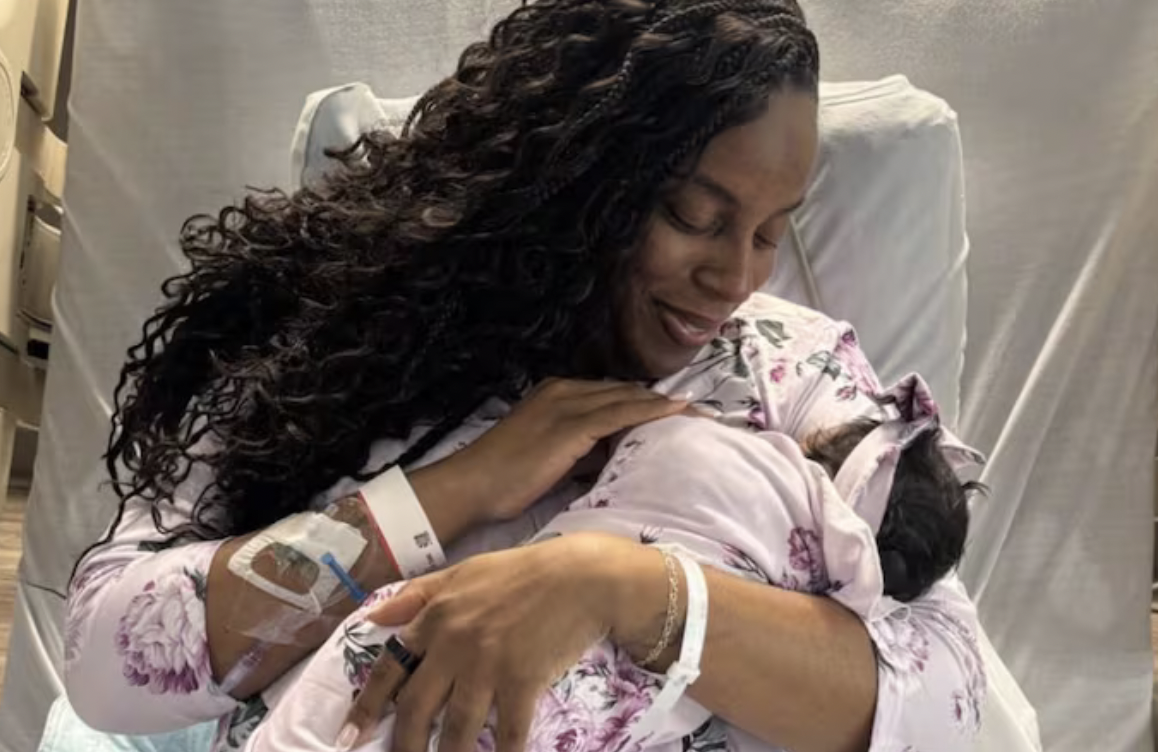
New Jersey Rep. LaMonica McIver has welcomed her second daughter as one of the most unusual legal battles involving a sitting member of Congress continues to play out in federal court.
The 40-year-old Democrat announced Thursday that she and her husband, Khalif Thomas, had welcomed a baby girl, bringing a moment of celebration to a year dominated by a high-profile criminal case stemming from a confrontation outside an immigration detention center in Newark. People.com
“We just welcomed our beautiful baby girl, and words can’t describe how blessed my family feels,” McIver wrote in announcing the birth, adding that being a mother is one of the greatest joys of her life.
McIver and Thomas also have an older daughter. When the congresswoman announced her pregnancy in May, she said she would not allow the prosecution to keep her from either doing her job or living her life. LaMonica McIver
But the legal cloud hanging over McIver remains significant.
She was indicted in June 2025 on three federal counts of forcibly assaulting, resisting, opposing, impeding, intimidating or interfering with federal officers following a chaotic May 9 confrontation at Delaney Hall, an immigration detention facility in Newark. McIver has pleaded not guilty. Department of Justice
McIver had traveled to the facility with two other members of Congress as part of an oversight inspection. Federal court records note that members of Congress had statutory authority to conduct the inspection. Newark Mayor Ras Baraka also arrived at Delaney Hall that day, setting off the confrontation that eventually led to McIver’s prosecution. Third Circuit Court of Appeals
According to the federal indictment, officers told Baraka he was not authorized to remain inside a secured area and later moved to arrest him.
Prosecutors allege McIver became physically involved as officers attempted to take the mayor into custody. The indictment accuses her of slamming her forearm into one federal officer, attempting to grab him and later using both forearms to strike a second officer while moving back toward the detention facility. Department of Justice
Those allegations remain unproven. McIver is presumed innocent unless convicted.
McIver has disputed the government’s characterization of the incident and argued that the prosecution was retaliatory and politically motivated. She has maintained that she was carrying out legitimate congressional oversight at the facility.
Her attorneys sought to have the case dismissed on several grounds, including the Constitution’s Speech or Debate Clause, separation-of-powers protections and claims of selective and vindictive prosecution. Third Circuit Court of Appeals
The case then produced a more complicated appeals ruling than some early reports suggested.
On Aug. 26, the U.S. Court of Appeals for the Third Circuit ruled that Counts One and Two could proceed because prosecuting those alleged acts would not require McIver to answer for protected legislative activity.
But the three-judge panel did not simply uphold the entire indictment. It vacated the lower court’s ruling involving Count Three and sent that portion of the case back to the district court for further consideration of McIver’s Speech or Debate Clause argument. The appeals court also said it did not have jurisdiction at that stage to consider several of her separate claims that she had been selectively or vindictively prosecuted. Third Circuit Court of Appeals
That distinction matters when discussing the potential prison sentence.
The Justice Department said when McIver was indicted that Counts One and Two each carry a statutory maximum of eight years in prison, while Count Three carries a maximum of one year. That produces the widely reported figure of 17 years if the statutory maximums are added together. Department of Justice
But 17 years is a maximum theoretical exposure, not a prediction of what McIver would actually receive if convicted. Any eventual sentence would depend on which charges survive, whether prosecutors obtain convictions and the federal sentencing process.
McIver has continued serving New Jersey’s 10th Congressional District while fighting the case.
The dispute has also raised a broader constitutional question over where congressional oversight protections end when lawmakers become involved in confrontations with federal law enforcement.
The Third Circuit acknowledged that McIver and the other representatives entered Delaney Hall for an authorized congressional inspection. The central legal question, however, is whether the specific physical actions prosecutors accuse McIver of taking were themselves protected legislative activity. For the first two counts, the appeals court concluded they were not. Third Circuit Court of Appeals
For now, McIver is balancing that continuing court fight with an entirely different chapter of her life at home.
Her new daughter arrives more than a year after the Delaney Hall confrontation began a federal case that could ultimately test the boundaries between congressional oversight authority and federal law-enforcement powers.
Discover more from
Subscribe to get the latest posts sent to your email.