

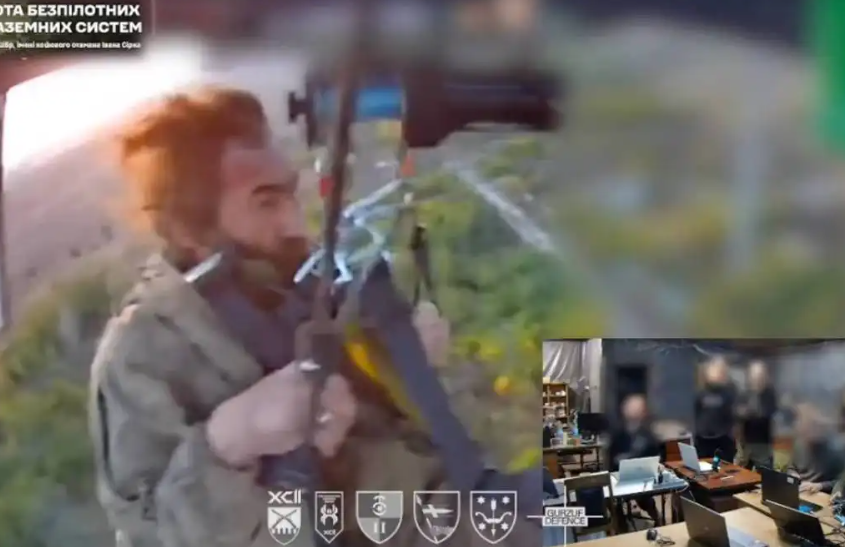
A Ukrainian soldier who survived 491 days in one of the most dangerous areas of the war, including months spent alone after his fellow soldier was killed, has finally been rescued in an extraordinary operation involving a massive flying drone.
Kostiantyn Vlasenko, 49, was stranded near the front lines in Ukraine’s northeastern Kharkiv region, where Russian drones, land mines and constant fighting made a conventional rescue nearly impossible.
During his ordeal, the father suffered devastating injuries to both legs and was forced to amputate his own right foot to survive. His left foot had already been lost after severely damaged tissue deteriorated.
Despite his injuries and the constant threat of Russian attacks, Vlasenko refused to surrender, surviving on food, water and medical supplies delivered by Ukrainian drones until his rescue on October 4.
His remarkable story emerged this week after Ukraine’s military released footage of what it described as the world’s first successful battlefield evacuation of a wounded soldier using a heavy aerial drone.
Vlasenko, a volunteer fighter from Kryvyi Rih serving with Ukraine’s 30th Separate Mechanized Brigade, initially occupied a defensive position near the Oskil River with another soldier.
The pair had been stationed at a location known as Vertun, where they used a concrete drainage pipe for protection from enemy fire.
After flooding forced them to relocate, they continued defending the area from an abandoned building.
But on February 16, Vlasenko’s fellow soldier was killed while attempting to move to another position, leaving him completely alone in territory surrounded by Russian forces.
The situation became increasingly desperate as Russian troops learned his location and attempted to persuade him to surrender.
According to Ukrainian reporting, Russian soldiers used loudspeakers to tell him that his comrades would not be able to rescue him.
Vlasenko refused to give up his position.
As the months passed, Russian drone attacks severely injured his legs, leaving him unable to walk or escape without assistance.
The injuries eventually became so serious that he made the desperate decision to amputate his right foot himself. His left foot had already been lost following complications from the injuries.
In interviews with Ukrainian journalists, Vlasenko described the experience as one of the most difficult moments of his life.
Even after losing his mobility, he continued communicating with his commanders through a radio while Ukrainian forces delivered supplies from the air.
Those deliveries became his lifeline, providing food, water, medication and occasional comforts that helped him endure the isolation.
His wife even arranged for him to receive Stephen King’s novel “The Outsider,” giving him something to read during the long periods of waiting.
Thoughts of his wife and daughter Khrystyna also helped him remain determined to survive.
However, with Russian surveillance drones constantly monitoring the area and land mines blocking potential escape routes, Ukrainian commanders struggled to find a way to bring him home.
Several proposed rescue missions were abandoned because military officials feared additional soldiers would be killed trying to reach him.
Vlasenko later admitted that he became so worried about the people attempting to save him that he began accepting the possibility he might never leave the position.
“I didn’t want them to leave anymore. I had already agreed to stay there forever,” he told Ukrainian outlet Fakty.
But his commanders refused to abandon him.
Approximately six months before the eventual rescue, a Ukrainian intelligence officer identified only by the call sign Alex suggested using a heavy cargo drone to lift Vlasenko out of the dangerous area.
The proposal was unlike a conventional military evacuation.
Instead of sending soldiers or an armored vehicle into the heavily monitored territory, the team would attempt to transport a person through the air using an unmanned aircraft.
Ukrainian engineers and military specialists eventually selected the Heavy Shot Ayudag-6, a powerful six-rotor drone developed by domestic manufacturer Gurzuf Defence.
The aircraft was designed to carry heavy equipment and could reportedly lift loads of up to 287 pounds.
Engineers modified the drone with a specialized lifting system that would allow the injured soldier to be carried beneath it.
The rescue required extensive testing and planning because a sudden movement, equipment failure or enemy attack could have put Vlasenko’s life in immediate danger.
Before the mission, Ukrainian forces delivered instructions explaining how he would attach himself to the aircraft.
The operation was finally launched on October 4, with Ukrainian forces coordinating reconnaissance, communications, protective drones and other support to help the aircraft reach the isolated soldier.
Vlasenko secured himself to the lifting system, and the drone carried him away from the dangerous position where he had spent more than a year.
After flying approximately 10 miles, he reached an intermediate evacuation point, where Ukrainian personnel transferred him to a remotely controlled ground vehicle.
The ground vehicle then carried him another five miles before medical crews were finally able to reach him and transport him to a treatment facility.
The combined operation allowed rescuers to avoid sending additional soldiers directly into some of the most dangerous terrain.
Vlasenko later described the flight as surprisingly peaceful.
“The flight was calm, I mostly looked around the area,” he told Ukrainian outlet Oboronka.
When he finally landed, he said he felt an overwhelming sense of relief knowing that he would soon see his family again.
Ukrainian military officials confirmed that Vlasenko survived the evacuation and is receiving medical treatment and rehabilitation.
His rescue has attracted international attention because it demonstrates a potentially important new use for drones in modern warfare.
While unmanned aircraft have become familiar tools for surveillance, deliveries and combat, carrying wounded soldiers through the air presents significantly greater technical challenges.
Heavy-lift drones have limited carrying capacity, can be vulnerable to enemy fire and require careful coordination to transport people safely.
Military experts have cautioned that such missions remain extremely risky and are unlikely to replace traditional medical evacuations.
Nevertheless, Ukraine’s successful operation could provide valuable lessons for rescuing wounded personnel from locations where helicopters, ambulances and ground vehicles cannot safely operate.
For Vlasenko, however, the importance of the operation is much more personal.
After 491 days in a war zone, months of isolation and injuries that permanently changed his life, the Ukrainian father is finally receiving medical care and looking forward to reuniting with the family that helped keep him going.
His survival is an extraordinary account of endurance, and his rescue demonstrates how far his fellow soldiers were willing to go to bring him home.
Discover more from
Subscribe to get the latest posts sent to your email.