

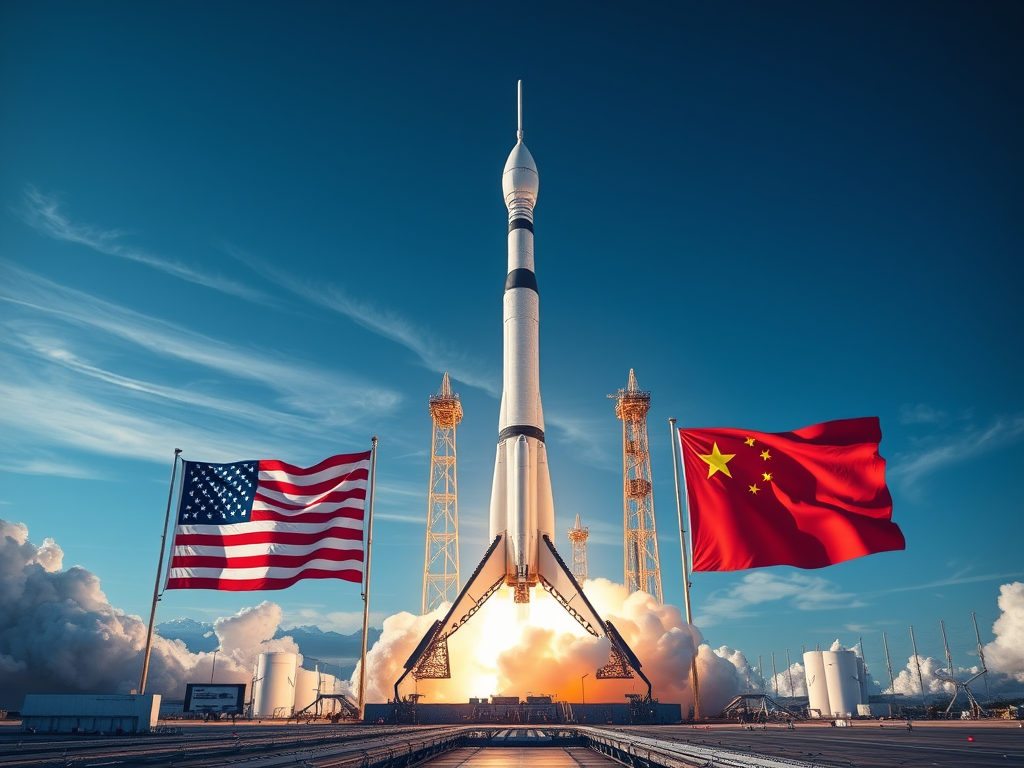
The space race is back—and this time, the stakes may be even higher.
A new bill in Congress, the Licensing Aerospace Units to New Commercial Heights (LAUNCH) Act, is being pitched as America’s shot to regain speed in the contest for dominance beyond Earth. Introduced Friday by Rep. August Pfluger (R-TX), the bill promises to slash red tape and fast-track private innovation in launches, reentries, and satellite technology.
“Space exploration and dominance are vital to America’s long-term strength and security,” Pfluger said. “As adversaries like China seek to weaponize and exploit the space domain, we must implement long-overdue reforms to keep the U.S. at the forefront.”
Pfluger, a former Air Force fighter pilot and National Security Council official under President Trump, said the bill modernizes rules to support innovation at spaceports nationwide, including Midland Spaceport in his Texas district.
Bipartisan Boost for Liftoff
The House proposal mirrors a Senate version introduced earlier this year by Sen. Rick Scott (R-FL) and Sen. John Cornyn (R-TX), with support from Democratic senators Ben Ray Luján (NM) and Mark Kelly (AZ)—the former astronaut who piloted four space missions. Even Marco Rubio backed an earlier version before leaving the Senate to join Trump’s cabinet as secretary of state.
Rep. George Whitesides (D-CA), a former NASA chief of staff and Virgin Galactic executive, also co-leads the effort. “I’ve seen firsthand how outdated and duplicative regulations can slow down American innovation,” he said. “The LAUNCH Act will cut red tape, improve coordination, and help U.S. companies compete in the global space economy.”
The push comes as Beijing accelerates its breathtaking march through the cosmos. China has landed rovers on the moon and Mars, and in 2019 became the first nation to place a craft on the far side of the moon. In 2021, it launched its own Tiangong space station—after being barred from the U.S.-led ISS. With the ISS scheduled to retire in the early 2030s, Tiangong could soon stand alone as the only state-run station orbiting Earth.
China and Russia are also planning the world’s first permanent moon base within the next decade, a goal that Washington is scrambling to match. Analysts warn Beijing is “living its Apollo, ISS, and commercial space eras all at once.” A recent report by the Commercial Space Federation concluded bluntly: “China’s space program has matured rapidly—meeting and often exceeding its goals, reshaping global space power, and posing complex risks to U.S. industry.”
Washington Gets Tough
The Trump administration has hardened America’s line. Beyond the 2011 Wolf Amendment that blocks NASA cooperation with Beijing, the space agency has now banned Chinese citizens with U.S. visas from its programs. NASA Administrator Sean Duffy went even further, declaring: “China is NOT going to the moon with good intentions. America will get there FIRST, preserving peace for both the U.S. and our international partners.”
Beijing insists otherwise. “China is committed to the peaceful use of outer space and opposes any arms race,” said Liu Pengyu, spokesperson for China’s embassy in Washington. “Understanding and exploring the universe is humanity’s shared aspiration.”
The Next Frontier
America still holds the largest fleet of satellites and dominated last year’s orbital launches—thanks largely to SpaceX. But history shows nothing is guaranteed. The Soviets once beat Washington into orbit with Sputnik and Yuri Gagarin. Now, with China’s relentless “Space Dream” and Washington’s regulatory bottlenecks, the outcome of this century’s space race is wide open.
For Pfluger and his allies, the LAUNCH Act is America’s answer. “This is about vision, courage, and leadership,” he said. “If we fail to act, we risk losing the final frontier.”
Discover more from True News Media
Subscribe to get the latest posts sent to your email.
The heavens declare the glory if God.Leave it alone.Fix the problems on Earth instead
Waste of money and energy, fix the earth…