

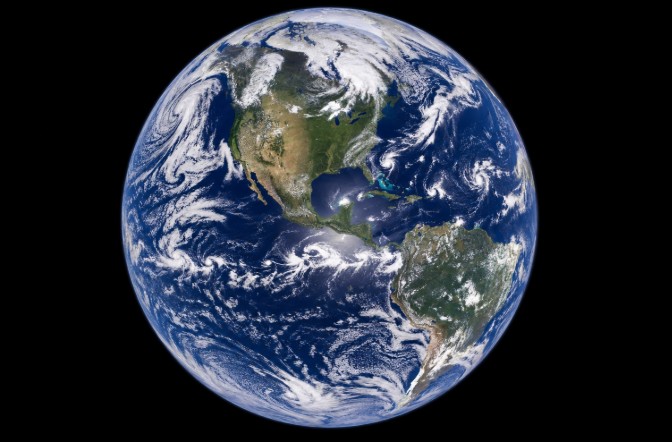
A former NASA astronaut says seeing Earth from space shattered one of the biggest assumptions humans live by.
Ron Garan, who spent 178 days in space and orbited the planet 2,842 times, said the view from above made him realize that humanity has built its priorities around what he now considers a “lie.”
Garan said the turning point came when he looked down at Earth and saw just how incredibly thin the atmosphere appeared.
“I saw the unbelievable thinness of our planet’s atmosphere,” he said.
That thin layer, he realized, is essentially what separates every living thing on Earth from the vacuum of space.
“In that moment, I was hit with the sobering realization that that paper-thin layer keeps every living thing on our planet alive.”
But the bigger realization came when Garan compared what he was seeing with the way modern society operates.
From space, Earth did not look like an economic machine divided into countries, industries and markets.
It looked like one fragile, interconnected living system.
Garan described the planet as “an iridescent biosphere teeming with life.”
That view led him to question the way humans have been taught to think about the economy and the natural world.
According to Garan, society often treats the planet’s forests, oceans, atmosphere and other life-support systems as if they exist primarily to serve economic growth.
He believes that thinking is backwards.
“Our human-made systems treat everything, including the very life-support systems of our planet, as the wholly owned subsidiary of the global economy,” Garan said.
Then came his most striking conclusion.
“It’s obvious from the vantage point of space that we’re living a lie.”
What Garan means is not that Earth itself is fake or that there is some hidden conspiracy.
His argument is that humanity has accepted a false hierarchy of priorities — one in which the economy is treated as more important than the planet that makes the economy, and human life itself, possible.
From orbit, he said, the opposite seemed obvious.
The economy exists inside human society, and human society exists inside Earth’s biosphere. Without a healthy planet, none of the other systems can survive.
Garan said being physically removed from Earth also changed the way he viewed people.
“The other thing I felt, and I can’t really explain it, is that being completely detached from Earth also made me feel deeply connected with everyone on the planet,” he said.
“It was this overwhelming kinship.”
Instead of seeing national borders or political divisions, Garan saw one planet supporting billions of people under the same thin atmosphere.
That experience permanently changed his outlook.
After leaving NASA, Garan became an outspoken advocate for environmental stewardship and for rethinking the way humanity measures success.
His central message is simple but dramatic: humans may have built much of modern civilization around the wrong priority.
And after seeing Earth from space, he says that mistake became impossible to unsee.
Discover more from True News Media
Subscribe to get the latest posts sent to your email.
He needs to put a sock in it.
Maybe he’ll share whatever he’s been smoking… stinking up the atmosphere…