

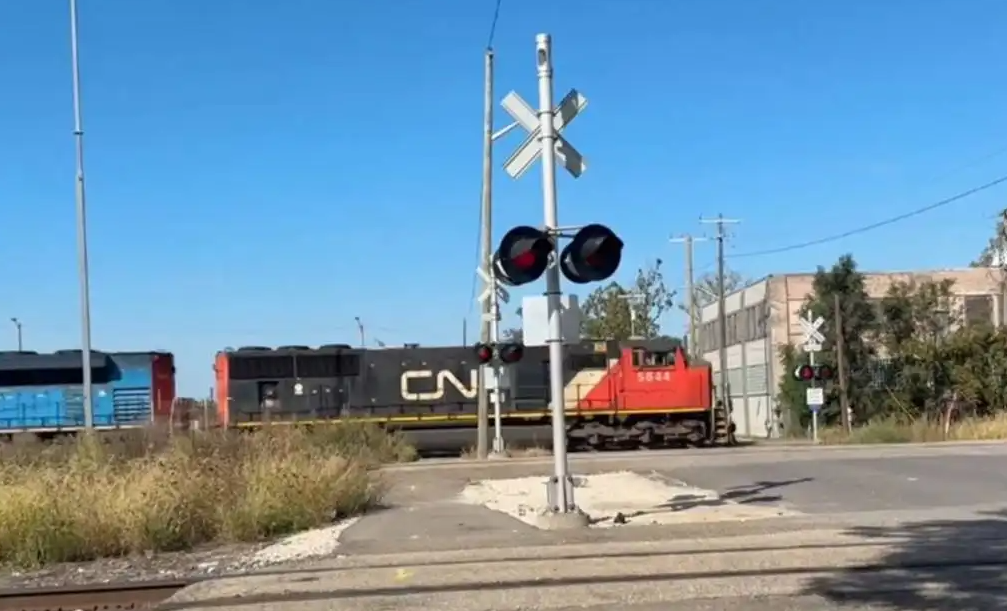
A 4-year-old Michigan girl has died, and her mother and older sister are fighting for their lives after the family was struck by a moving train while attempting to cross railroad tracks near a high school.
The heartbreaking tragedy unfolded Sunday evening, October 4, in Ecorse, a small community just south of Detroit, where a mother and her two young daughters were walking near a set of railroad tracks.
According to investigators, the family was attempting to cross the tracks near a stopped train when another train came through and struck all three of them.
The youngest victim, 4-year-old Raniyah Chambliss, suffered fatal injuries.
Her 32-year-old mother and 10-year-old sister were rushed to a hospital in critical condition, leaving their loved ones facing an unimaginable nightmare.
The tragedy has also exposed troubling concerns about the railroad crossing, where residents say stopped trains frequently block the tracks for hours, prompting pedestrians to take dangerous shortcuts.
Police say the incident occurred around 6:30 p.m. near Salliotte Road and Fifth Street, not far from Ecorse High School.
Emergency dispatchers received a report that three pedestrians, including two children, had been struck by a passing train.
When first responders arrived, they discovered the mother and her two daughters suffering from severe injuries.
Paramedics immediately began treating the victims before transporting them to Corewell Health for emergency medical care.
Early reports indicated that all three had sustained serious head injuries.
Despite doctors’ efforts, the youngest child did not survive.
Raniyah’s father later confirmed her identity to Detroit television station WXYZ, describing his daughter as a beautiful little girl who meant everything to him.
The loss has devastated the family as they continue worrying about the two surviving victims.
As of the latest reports Wednesday, October 7, Raniyah’s mother and older sister remained hospitalized in critical condition. No newer verified medical update was available Thursday.
Investigators have since revealed a particularly frightening detail about how the tragedy may have occurred.
According to the Ecorse Police Department, preliminary evidence suggests that the family was trying to cross the railroad tracks while one train was stopped nearby.
At the same time, another train approached and struck them.
Police have not yet determined exactly how the family entered the tracks or whether the stationary train prevented them from seeing the approaching locomotive.
However, the circumstances have raised concerns about the risks created when one train obstructs the view of another.
A stopped train can create a dangerous blind spot, making it difficult for pedestrians to notice another train approaching on an adjacent track.
And unlike cars, trains cannot stop quickly when someone suddenly appears in their path.
Authorities say the exact sequence of events remains under investigation.
Initial findings do not suggest that alcohol or drugs played a role.
Following the tragedy, residents spoke out about what they described as a longstanding problem involving trains blocking the neighborhood’s railroad crossings.
Some claimed that trains regularly remain stopped for extended periods, sometimes for hours, making it difficult for pedestrians to travel between neighborhoods.
One local resident, William Wilson, told WWJ Newsradio that stopped trains often obstruct his view when attempting to cross the tracks with his young son.
He explained that navigating around the trains can be frustrating, particularly for people trying to reach destinations on foot.
Another woman described regularly witnessing children and adults climbing through or around stopped railroad cars.
She said the behavior makes her nervous because another train could approach without being visible.
“Very dangerous,” the woman told WWJ, explaining that people sometimes cannot see another train coming.
She also described seeing high school students and parents helping children through stopped trains in an attempt to reach the other side.
The accounts suggest that the problem extends beyond one family or one tragic evening.
Residents say the crossing has become a daily challenge for people who live nearby, particularly those who do not have vehicles.
Local 4 News in Detroit reported seeing pedestrians continue crossing near stopped trains even after Sunday’s tragedy.
In one instance, a father and his young son were observed crossing the tracks while warning gates were down.
Another resident, Donhavon Neal, acknowledged that he frequently uses the crossing despite recognizing the dangers.
He said trains can begin moving unexpectedly, leaving pedestrians with little time to react.
Neal also described the inconvenience of avoiding blocked tracks.
According to the station, walking to a nearby underpass instead takes approximately seven minutes.
For residents who travel on foot several times a day, that detour can be frustrating.
But Sunday’s tragedy demonstrates how dangerous attempting to bypass a stopped train can become.
The National Highway Traffic Safety Administration and Federal Railroad Administration have repeatedly warned that railroad crossings present serious hazards for motorists and pedestrians.
A train traveling at highway speeds can require a mile or more to stop, depending on its length, weight and operating conditions.
Because trains are restricted to their tracks, engineers have limited options when someone unexpectedly enters their path.
The safest approach is to use designated crossings, obey warning signals and never climb over, underneath or between railroad cars.
Following the fatal incident, Ecorse Police Chief Derran Shelby issued a warning urging residents to take those precautions seriously.
Shelby expressed condolences to the family and emphasized that even a stationary train can present serious risks.
“A stopped train can block your view of another approaching train, and railroad equipment can move unexpectedly,” he said.
The police chief also warned pedestrians never to attempt to pass between train cars or crawl underneath them.
His statement came as investigators continued examining what happened near the Salliotte Road crossing.
Authorities have not announced any criminal charges or publicly identified wrongdoing by the railroad company.
CN Rail operates in the region, although officials have not publicly established whether equipment or operational practices contributed to the tragedy.
The incident has renewed discussions about whether communities should have additional safeguards at railroad crossings frequently blocked by stopped trains.
Possible safety measures can include pedestrian barriers, warning systems, clearer signage and improved access to alternative crossings.
However, officials have not announced any specific changes for the Ecorse location.
For now, the investigation remains focused on reconstructing the incident and determining whether any safety failures contributed to the family’s injuries.
For Raniyah’s loved ones, those answers cannot undo the devastating loss.
The little girl was only 4 years old, with her entire childhood ahead of her.
Her father is now grieving the loss of his daughter while her mother and 10-year-old sister continue receiving treatment for their injuries.
What should have been an ordinary Sunday evening ended with one child dead and two family members fighting to recover.
The tragedy has shaken the Ecorse community and left residents questioning how many more dangerous encounters might happen at the railroad crossing.
As investigators work to determine exactly what went wrong, one painful reality remains.
Discover more from
Subscribe to get the latest posts sent to your email.