

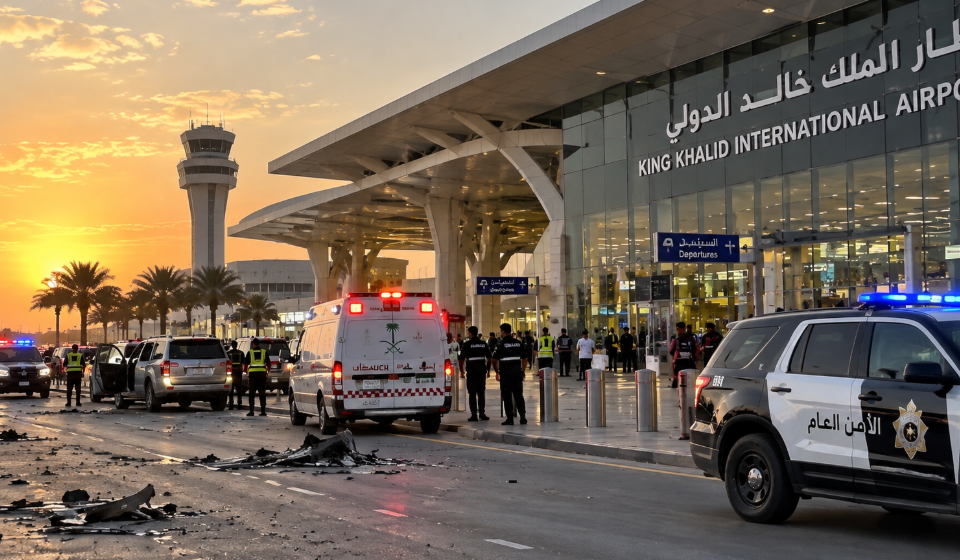
At least 12 people, including an American citizen, were killed and more than 300 injured after a missile strike tore through a busy international airport in Saudi Arabia, sending terrified passengers scrambling for safety as violence in the Middle East continues to escalate.
The deadly attack struck King Khalid International Airport in Riyadh on Saturday, October 10, damaging passenger terminals and forcing authorities to suspend flights at one of the region’s busiest transportation hubs.
Saudi officials blamed Yemen’s Iran-backed Houthi rebels, who have intensified their attacks on the kingdom amid a widening regional conflict. The group later claimed responsibility, describing the strike as retaliation for Saudi military operations in Yemen.
According to Saudi Arabia’s General Authority of Civil Aviation, 12 people were killed and 309 others injured, including several who remained in critical condition. Among the dead were four Saudi citizens, two Bangladeshis and one person each from the United States, Egypt, Jordan, Syria, Palestine and Sudan.
The attack marked the deadliest strike on a Gulf Arab country since the war involving Iran began in February, raising concerns that the conflict could spread further across the region.
Passengers described frightening scenes as an explosion rocked the airport, sending people running from terminals while emergency crews rushed to help the injured.
One traveler who was waiting near Gate 403 told the Times of Israel that he saw an explosion near Gate 401.
“I saw injured in front of my eyes. Everyone was running,” the witness recalled.
Emergency responders descended on the airport as smoke rose from the damaged facilities. Ambulances transported injured travelers and airport workers to nearby hospitals, while security personnel evacuated affected areas.
Saudi authorities temporarily suspended airport operations to assess the damage and determine whether the terminals and runways were safe. The shutdown caused widespread flight disruptions, with hundreds of arrivals and departures canceled or diverted.
The incident was especially alarming because it was the third attack on King Khalid International Airport within a week. Earlier strikes had already killed several people and damaged airport infrastructure, underscoring the growing threat to civilian aviation.
In response to Saturday’s attack, the U.S. Embassy in Riyadh issued an urgent security warning, strongly advising American citizens to avoid the airport and surrounding areas.
The warning came as the United States confirmed that one American was among those killed, bringing the escalating conflict closer to home for U.S. travelers and their families.
The Houthis, an armed movement that controls much of northern Yemen, have been fighting Saudi-backed forces for years. Supported by Iran, the group has increasingly targeted airports, oil facilities, ships and other infrastructure as regional tensions have intensified.
Senior Houthi official Mohammed al-Bukhaiti defended the latest attack, arguing that civilian facilities in Yemen deserve the same protections as those elsewhere.
He claimed the strike was intended to draw attention to Saudi-led military operations that the group says have harmed civilians in Yemen.
However, attacks intentionally targeting civilians and civilian facilities are prohibited under international humanitarian law. Saudi military officials condemned the airport strike as a war crime and warned that the kingdom would respond.
The violence has intensified since a fragile truce in Yemen broke down earlier this year, reigniting fighting between the Houthis and forces aligned with Yemen’s internationally recognized government.
The broader regional conflict has also disrupted energy production and shipping routes, including the Red Sea and the strategically important Strait of Hormuz, through which a significant portion of the world’s oil supplies normally passes.
For Saudi Arabia, the repeated attacks present a serious challenge to both national security and its efforts to attract international visitors and investment.
King Khalid International Airport serves as a major gateway to Riyadh, handling international travelers, business delegations and domestic flights throughout the kingdom. Its closure has disrupted travel plans across the region and prompted several international airlines to suspend or cancel services.
The attack has also increased pressure on Washington to decide whether to become more directly involved in Saudi Arabia’s military campaign against the Houthis.
President Donald Trump condemned the violence and acknowledged that the United States was considering possible participation in military operations against the group.
“We may. We’re gonna look at it,” Trump said when asked whether American forces could join Saudi strikes.
Secretary of State Marco Rubio also condemned the attack, while U.S. officials continued monitoring threats to Americans in the region.
With airport operations disrupted and further attacks possible, foreign embassies have urged travelers to monitor official security updates and avoid affected areas.
Saudi authorities are continuing to assess the damage and provide medical care to the injured, while the military weighs its response to the repeated strikes.
Discover more from
Subscribe to get the latest posts sent to your email.