

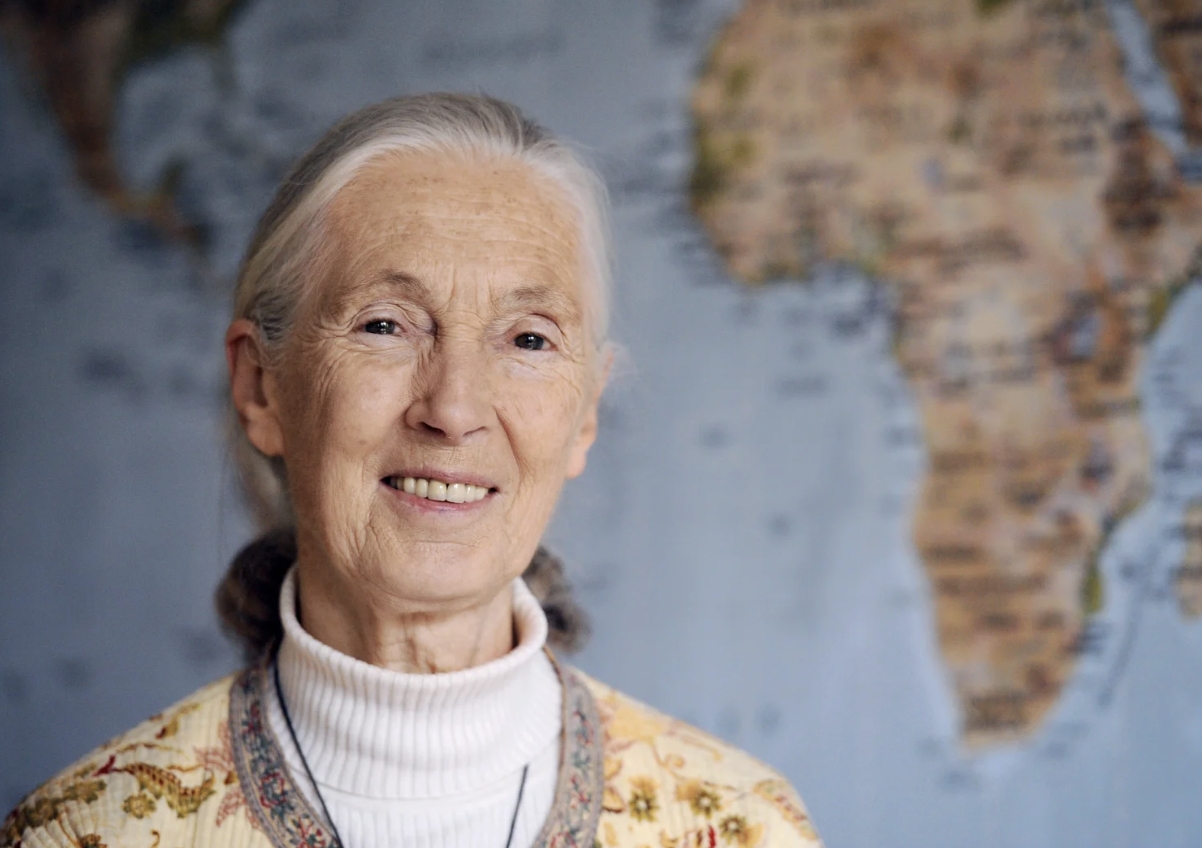
Jane Goodall, the British researcher whose work with wild chimpanzees forever changed the way humans see themselves, has died at 91. Her institute confirmed Wednesday that she passed away of natural causes while on a speaking tour in California.
Goodall’s death closes the final chapter on one of the most unlikely success stories in modern science — a young woman with no degree, little money, and a childhood crush on Tarzan who went on to become the world’s most famous primatologist.
Born in London in 1934, Goodall grew up fascinated by animals but had no path to higher education. “My mother said, ‘If you want to go to Africa, learn secretarial work — you can get a job anywhere,’” she recalled years later.
By 1957, she’d saved enough money from waitressing to buy a one-way ticket to Kenya. There, she landed a job with famed paleontologist Louis Leakey, who was struck by her passion and intuition. “He discovered immediately a very vibrant, very passionate young woman who was utterly focused on animals,” biographer Dale Peterson once said.
Leakey believed someone should study humanity’s closest relative — the chimpanzee. In 1960, he sent Goodall into the forests of what is now Gombe Stream National Park in Tanzania. Officials balked at a woman living alone in the bush, so Goodall brought her mother as a chaperone.
The work was grueling. The chimps fled from her. Both women contracted malaria. Yet Goodall persisted, approaching the animals with patience and bananas. Within months she made a discovery that rocked the scientific world: chimps could use tools.
“Man was defined as the only toolmaking animal,” she later recalled. “Louis Leakey said, ‘We must now redefine tool, redefine man, or include chimpanzees with humans.’”
Goodall’s habit of giving the chimps names — David Greybeard, Flo, Fifi — raised eyebrows. Many scientists dismissed her for describing them as having “personalities.” But her honesty and empathy proved undeniable.
“They kiss, embrace, hold hands, pat one another on the back,” she explained. “They show love and compassion, and they also show violence and primitive warfare. Because they are so like us, we must ask: what makes us unique?”
Her work wasn’t always comforting. Goodall was shaken to discover that chimps commit brutal assaults, even infanticide and cannibalism. “I was shocked. I was saddened. But I realized, very sadly, this makes them even more like us.”
By the mid-1960s, Goodall was an international celebrity. She graced the cover of National Geographic, starred in documentaries, and was compared to Tarzan’s fictional Jane. She married twice, raised a son, and in 1977 founded the Jane Goodall Institute, which would become a global voice for conservation.
Everything changed for Goodall in 1986 when she attended a conference in Chicago and learned of the horrors facing chimpanzees — poaching, habitat loss, and medical experimentation.
“I realized I had to stop living selfishly in my own little paradise and use the knowledge I’d gained to do what I could to help,” she said.
From then on, she became less a researcher than an activist. Tireless and blunt, she crisscrossed the globe delivering lectures, urging leaders to protect wildlife, and inspiring millions. Her work expanded to climate change, deforestation, and youth activism.
Sometimes she was asked which she preferred: chimps or people. Her answer was pure Goodall. “It depends,” she said. “I like some people much more than some chimps, and some chimps much more than some people.”
To admirers, Goodall was more than a scientist — she was a cultural icon who gave animals individuality in an era when they were seen as mere machines. Harvard anthropologist Richard Wrangham called her “rock-solid honest” and praised her “tremendous empathy.”
Goodall herself once admitted her journey began with a childhood fantasy. “I fell in love with Tarzan,” she laughed in a 1990 interview. “I was terribly jealous of Jane. I thought she was a wimp. I’d have been much better for him.”
Instead, she became “Jane” to the world in her own right. A woman who, against all odds, lived among chimpanzees and made us see ourselves more clearly in the process.
She is survived by her son, Hugo, and grandchildren.
Discover more from True News Media
Subscribe to get the latest posts sent to your email.
Hope she knew the Lord as her Savior
She lived a good long interesting life and helped us with some insights… too bad about the one that got away… Tarzan…
Great admiration for this Lady.