

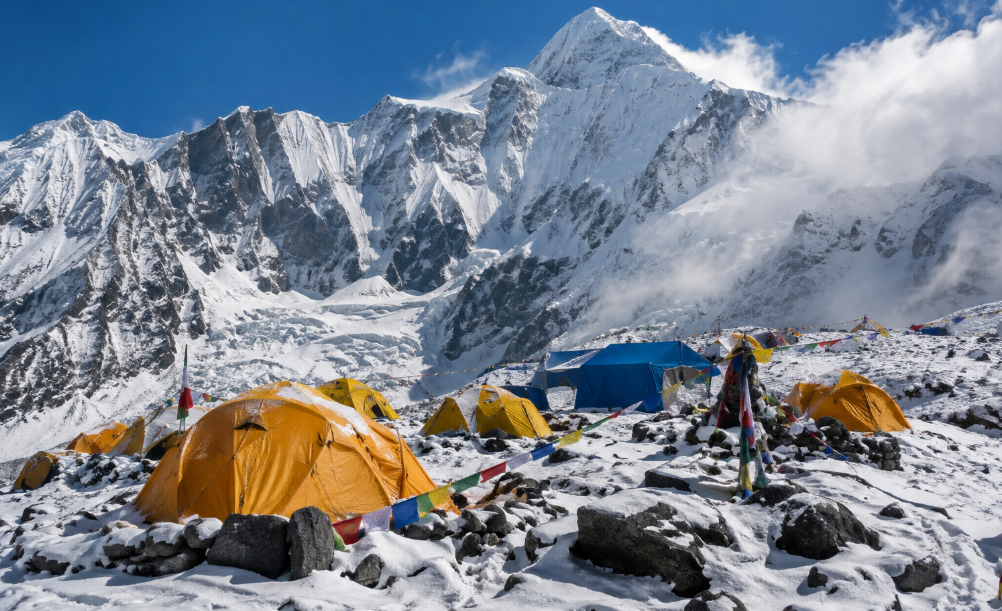
At least 15 Nepali workers have been killed after a massive avalanche buried a Himalayan mountain camp they were preparing for foreign climbers, leaving one additional worker missing.
The avalanche struck Himlung Himal, a 23,379-foot mountain in Nepal’s Manang district, on September 26 as workers were getting the remote camp ready for the country’s autumn climbing season.
The victims were part of a group of Nepali guides and support workers who had traveled ahead of international climbing teams to prepare the route and camps.
Their work included pitching tents, fixing ropes and preparing areas that climbers would later use during attempts to reach the summit.
But before the foreign climbers arrived, an avalanche swept through the camp and buried 16 workers beneath snow and ice.
By Thursday, October 1, search teams had recovered 15 bodies.
Eight of the victims were recovered Thursday after rescuers reached the avalanche zone and searched through the debris. Seven others had been found earlier in the week.
One worker remained missing.
Tul Singh Gurung, president of the Nepal National Mountain Guide Association, said hopes of finding the final missing worker alive were fading and the search operation was expected to end soon.
No foreign climbers were at the camp when the avalanche struck.
Local officials said the disaster occurred near the Himlung Himal base camp in Narpa Bhoomi Rural Municipality in northern Manang, a remote mountainous region close to Nepal’s border with China.
Rescue efforts were difficult from the beginning.
Bad weather and dangerous flying conditions prevented helicopters from immediately reaching the mountain, leaving specialized rescue teams facing a challenging trip into the disaster zone.
Once conditions improved, experienced mountain guides were flown closer to the site and began searching areas where the workers were believed to have been buried.
Authorities said Thursday that several recovered bodies were flown to the nearby villages of Phu and Chame, where officials were completing legal and identification procedures.
The victims were expected to eventually be returned to their families.
Himlung Himal rises 7,126 meters, or about 23,379 feet, and is located in Nepal’s remote Nar Phu region.
Although far less famous than Mount Everest, the mountain attracts international climbers seeking experience at elevations above 7,000 meters.
Expeditions at those heights depend heavily on Nepali workers.
Long before paying climbers begin their summit attempts, local guides, porters, cooks and other support staff may travel onto the mountain carrying equipment and establishing camps.
High-altitude workers can also be responsible for placing ropes, transporting supplies and preparing routes through snow, glaciers and steep terrain.
That work can put them in some of the most dangerous areas of the mountain before expedition clients ever arrive.
The Himlung Himal avalanche has become the deadliest incident of Nepal’s current autumn climbing season.
It also struck during a period of severe weather across Nepal.
Heavy rain has triggered deadly floods and landslides in other parts of the country, damaging roads and infrastructure and complicating rescue operations in mountainous areas.
The Himalayas have also faced increasing scrutiny from scientists studying the effects of rising temperatures on glaciers and high-altitude snow and ice.
Researchers have warned that warming temperatures and retreating glaciers can contribute to changing and sometimes less predictable conditions in mountain regions.
However, officials have not determined exactly what triggered the September 26 avalanche at Himlung Himal.
For families of the victims, the disaster is also another reminder of the risks faced by Nepal’s mountain workers, whose labor supports a major part of the country’s adventure tourism industry.
Thousands of foreign visitors travel to Nepal each year to trek and climb in the Himalayas, creating jobs for guides, porters, cooks and other expedition workers.
Many of those workers face the mountains’ dangers first.
As of Thursday night, rescuers were still trying to account for the final missing worker while preparations continued to bring the recovered victims home.
Discover more from
Subscribe to get the latest posts sent to your email.