

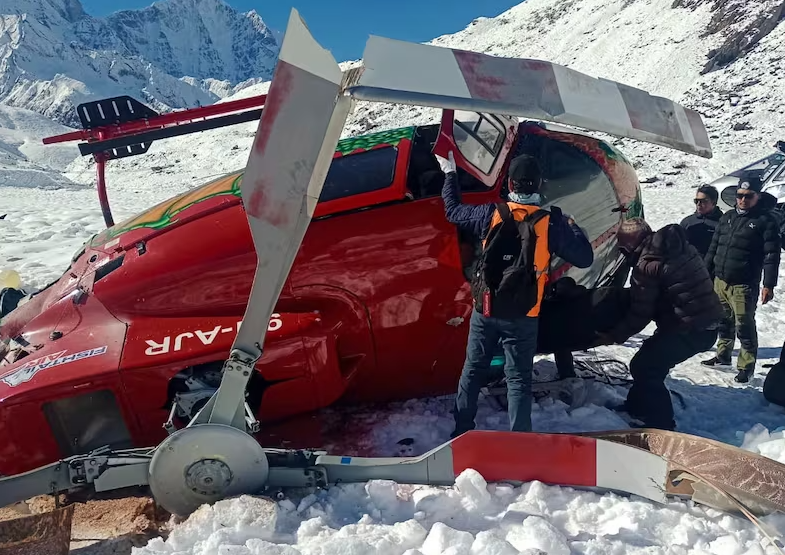
A tourist was killed and three others were injured Tuesday when two helicopters collided in midair near Mount Everest, sending the aircraft crashing into the snowy mountainside in a terrifying accident captured on video.
The deadly collision unfolded around 8:11 a.m. local time on November 3 near Pheriche, a remote Himalayan village in Nepal’s Solukhumbu district, as both helicopters attempted to land at the same helipad.
Dramatic footage circulating on social media shows the aircraft approaching from opposite directions just above the snow-covered ground. Within seconds, their rotor blades strike, causing both helicopters to crash as horrified witnesses rush toward the wreckage.
Authorities identified the victim as Vasanth Kumar Balaramudu, a 47-year-old tourist from Chennai, India. He was traveling aboard a helicopter operated by Fishtail Air when the collision occurred.
Three others were injured, including 49-year-old Shailesh Krishna Patel, a New Zealand citizen of Indian origin, and the pilots of both helicopters.
Patel and Fishtail Air pilot Rabindra Prajapati were evacuated to Nepal Mediciti Hospital in Kathmandu for treatment. The second pilot, Prajwal KC of Air Dynasty, also suffered injuries and received medical attention.
The crash occurred during one of the busiest trekking periods in the Everest region, where helicopters play a crucial role in transporting visitors and rescuing hikers who become ill or exhausted in the extreme mountain conditions.
Heavy snowfall had recently disrupted travel along the popular route to Everest Base Camp, leaving trekkers struggling to navigate snow-covered trails. Although the weather improved Sunday, helicopters continued operating in the region to assist travelers.
According to Nepalese aviation officials, the Fishtail Air helicopter had departed from Gorakshep carrying two foreign nationals, while the Air Dynasty aircraft was arriving from Lukla on a cargo flight.
Both were attempting to land at Pheriche, situated more than 13,000 feet above sea level, when disaster struck.
Investigators are now examining whether a breakdown in communication between the pilots contributed to the collision.
Mukesh Dangol, director general of Nepal’s Civil Aviation Authority, said preliminary information suggested possible miscommunication. The helipad lies outside the coverage area of Lukla Airport’s air traffic control tower, meaning pilots must coordinate their approaches directly with one another.
Authorities have not established an official cause, and the investigation remains ongoing.
The tragedy has renewed concerns about aviation safety in Nepal’s mountainous regions, where rapidly changing weather, extreme elevations and challenging terrain make helicopter operations especially demanding.
The Everest region depends heavily on air transportation because there are no roads connecting the mountain’s high-altitude trekking destinations. Helicopters are often the only option for evacuating travelers who cannot safely make the journey back down on foot.
For the tourists and crews involved Tuesday, what should have been a routine landing ended in catastrophe.
The collision is believed to be Nepal’s first recorded midair crash involving two helicopters, raising fresh questions about flight coordination in one of the world’s most challenging aviation environments.
Discover more from
Subscribe to get the latest posts sent to your email.