

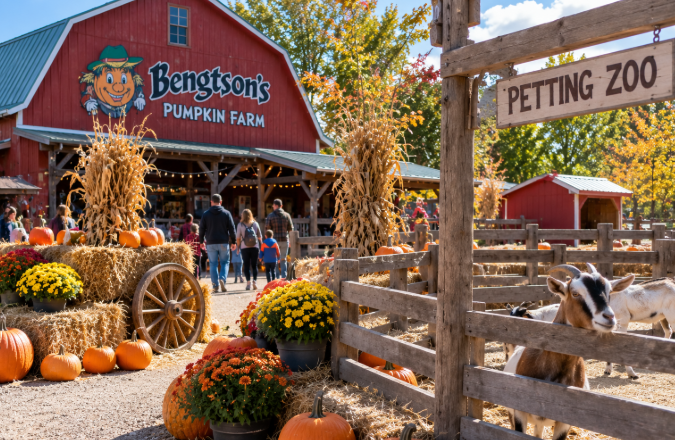
A popular Illinois pumpkin farm has shut down its petting zoo after five people tested positive for a potentially dangerous strain of E. coli, raising concerns among families visiting the attraction during the busy Halloween season.
The Will County Health Department announced Friday, October 23, that it was investigating five confirmed infections that may be connected to visits to Bengtson’s Pumpkin Farm in Homer Glen, a popular fall destination about 30 miles southwest of Chicago.
All five people had visited the farm earlier this month, but investigators have not yet determined where or how they became infected.
The patients range in age from 4 to 38 and live in four different Illinois counties: Will, DuPage, Cook and Kane.
The infections involve Shiga toxin-producing E. coli, commonly called STEC, a type of bacteria that can cause severe stomach cramps, diarrhea, vomiting and potentially serious complications.
With Halloween approaching and families flocking to pumpkin patches, hayrides and animal attractions, the health department is urging recent visitors to watch for symptoms.
The farm’s petting zoo has been voluntarily closed while investigators examine whether contact with animals, contaminated food, water or another source could explain the illnesses.
Sean Conners, director of environmental health for Will County, said officials are working closely with the business to determine whether the five infections share a common source.
He emphasized that the owners and employees have been fully cooperative throughout the investigation.
The farm was first contacted by health officials on Wednesday, October 21, and closed its petting zoo as a precaution.
However, the rest of the attraction remains open, including its seasonal activities.
In a statement, Bengtson’s Pumpkin Farm said it was deeply concerned about the people who became sick and hoped they would recover quickly.
The business also stressed that no source of contamination has been confirmed.
According to the owners, health inspectors examined the farm’s food service areas and vendors on October 21 and found no problems.
The farm has also arranged for a veterinarian to collect samples from its animals so they can be tested as part of the investigation.
Its petting zoo will remain closed until further notice.
Bengtson’s has welcomed families since 1981 and is known for its pumpkin displays, amusement rides, seasonal food and opportunities for children to interact with farm animals.
Co-owner Scott Bengtson told CBS Chicago that the animal attraction has operated for more than a decade without a previous incident like this.
He said the petting zoo has handwashing stations equipped with running water, soap and towels, along with staff supervision and daily cleaning procedures.
Nevertheless, health officials say even apparently healthy animals can carry bacteria capable of making people sick.
E. coli can spread when someone touches an infected animal or a contaminated surface and then accidentally transfers the bacteria to their mouth.
Infections can also result from contaminated food or water, which is why investigators are examining several possible sources rather than assuming the animals were responsible.
Symptoms generally begin three to four days after exposure, although they can appear anywhere from one to ten days later.
Most people recover within about a week, but certain infections can become dangerous, especially for young children, older adults and people with weakened immune systems.
In severe cases, STEC can lead to hemolytic uremic syndrome, a complication that can damage the kidneys.
Health officials are particularly concerned about warning signs such as bloody diarrhea, intense stomach pain, unusual fatigue, dehydration or decreased urination.
Anyone experiencing those symptoms should seek medical attention promptly.
The department is also asking anyone who visited Bengtson’s Pumpkin Farm on or after September 29 and subsequently developed stomach-related symptoms to complete a confidential online health survey.
The information could help investigators determine whether additional illnesses occurred and identify a possible common exposure.
Meanwhile, officials are reminding families that washing hands thoroughly with soap and water is one of the most effective ways to prevent the spread of E. coli.
Handwashing is especially important after touching animals, visiting a petting zoo, using the bathroom or handling anything that may have been contaminated.
Children should also avoid eating or putting their fingers in their mouths until they have washed their hands after interacting with animals.
As of Saturday, October 24, health officials had not announced additional confirmed cases or identified the source of the infections.
The investigation remains ongoing, and the petting zoo is staying closed while animal testing and other examinations continue.
For families planning a fall outing, officials are emphasizing that the reported illnesses warrant attention but do not establish that Bengtson’s Pumpkin Farm caused the infections.
The goal now is to determine what happened, prevent any additional illnesses and ensure visitors have the information they need to protect themselves.
Discover more from
Subscribe to get the latest posts sent to your email.