

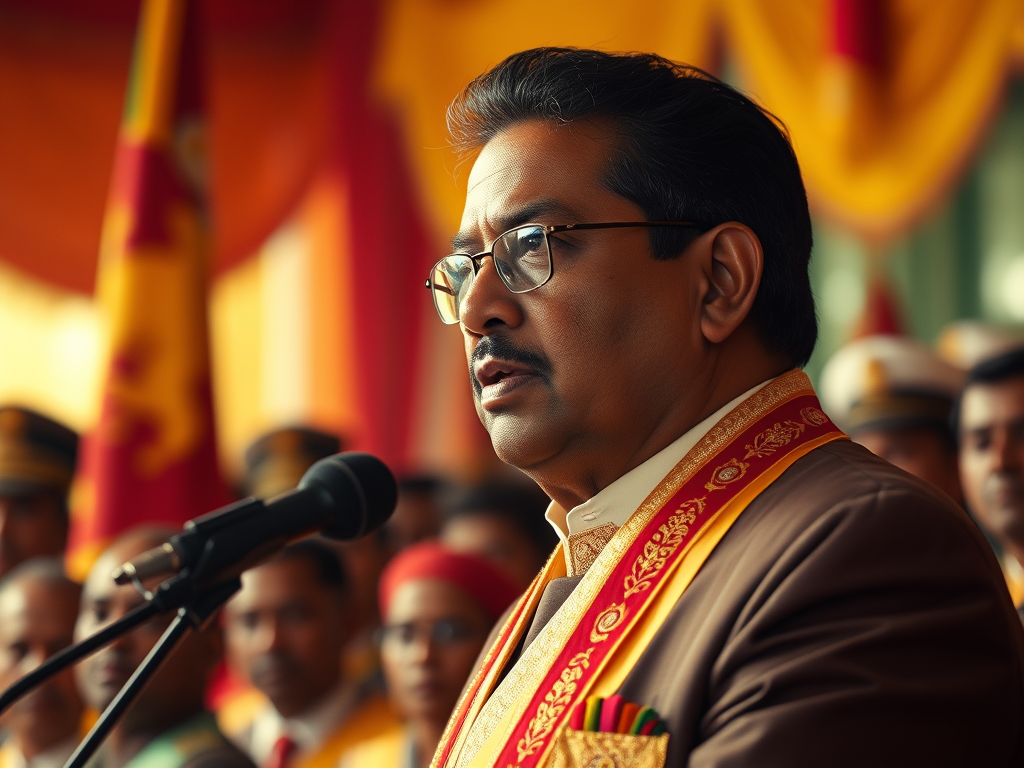
In a stunning turn of events, Sri Lanka has just sworn in Anura Kumara Dissanayake, a hardline Marxist, as its new president. Dissanayake, who leads the People’s Liberation Front (JVP)—a political party with a history of violent uprisings—defeated President Ranil Wickremesinghe on Monday, ushering in a new era that could have serious consequences for the already fragile country.
Now let’s be clear: This isn’t just another politician taking office. Dissanayake, 55, leads a party that’s not shy about its roots in Marxist ideology. This is a group that launched two armed insurrections in the 1970s and 1980s, leading to thousands of deaths. And now they’re in charge of a country that’s been teetering on the edge of economic collapse for years. What could go wrong?
During his swearing-in ceremony, Dissanayake didn’t exactly sound like a man with a plan to fix the country’s deep problems. He acknowledged that Sri Lanka is a “challenging country,” and admitted that neither a single party nor an individual could resolve the crisis. But here’s the real kicker: Who’s stepping up to help him? China’s President Xi Jinping was one of the first to congratulate him, saying China looks forward to “carrying forward our traditional friendship.” Translation: China’s getting its claws deeper into Sri Lanka, and Dissanayake is more than willing to let them.
This is bad news for the U.S., and it’s bad news for India too. Both countries congratulated Dissanayake, but let’s not forget what’s really at stake here. Sri Lanka sits in a strategically critical location just south of India, and China has been eyeing this island for years as part of its Belt and Road Initiative—a project plagued by corruption, debt traps, and political backlash. Under Dissanayake’s Marxist leadership, Sri Lanka is poised to lean even further into China’s orbit, giving Beijing another foothold in the Indian Ocean.
Let’s not forget the economic disaster that has plagued Sri Lanka since 2022. Inflation hit an astounding 70%, thanks to a severe shortage of U.S. dollars. The country’s GDP has finally shown signs of growth for the first time in three years, but don’t be fooled. The growth is barely a blip compared to the deep-rooted economic issues Sri Lanka faces, and Dissanayake’s hardline policies aren’t exactly going to bring prosperity.
The real challenge for Dissanayake will be whether he can live up to his campaign promises—namely, easing austerity measures imposed by his predecessor under the watchful eye of the International Monetary Fund (IMF). Sri Lanka is neck-deep in debt, and the IMF is their largest creditor. But here’s the problem: Dissanayake’s entire political platform is built on rejecting the very austerity that the IMF insists is necessary for economic recovery. So where does that leave Sri Lanka? Caught between Marxist fantasy and harsh economic reality.
This is the first peaceful transfer of power since 2022, when the people of Sri Lanka literally rioted in the streets, forcing then-President Gotabaya Rajapaksa to flee the country. Wickremesinghe stepped in to stabilize things, but now the pendulum has swung in the opposite direction with Dissanayake taking control.
Sri Lanka is a Buddhist-majority country with 22 million people, roughly the size of West Virginia, but with a political culture that’s utterly disillusioned. The People’s Liberation Front has taken advantage of that disillusionment, promising a Marxist utopia while steering the country straight into the arms of China.
The world needs to pay attention here. This is not just a local issue—it’s a geopolitical flashpoint. Sri Lanka’s economic collapse, paired with China’s growing influence, could destabilize the entire region. And under Dissanayake, we’re seeing a shift toward Marxism, anti-Western rhetoric, and more dependence on China.
So what does this mean for the United States? Well, under the current administration, don’t expect much. President Biden has shown a complete lack of foreign policy strategy, especially when it comes to countering China’s influence around the world. Sri Lanka’s shift toward Marxism and China is just another example of how this administration has allowed China to fill the void where American leadership used to stand.
It’s a dangerous situation, and if the U.S. doesn’t wake up to what’s happening in Sri Lanka, we could be looking at another major loss in the global struggle against Chinese expansion.
One thing is clear: Sri Lanka is about to change in ways that could have far-reaching consequences for the region and the world. And as usual, the American people will be left asking why their government wasn’t paying attention until it was too late.
Discover more from
Subscribe to get the latest posts sent to your email.