

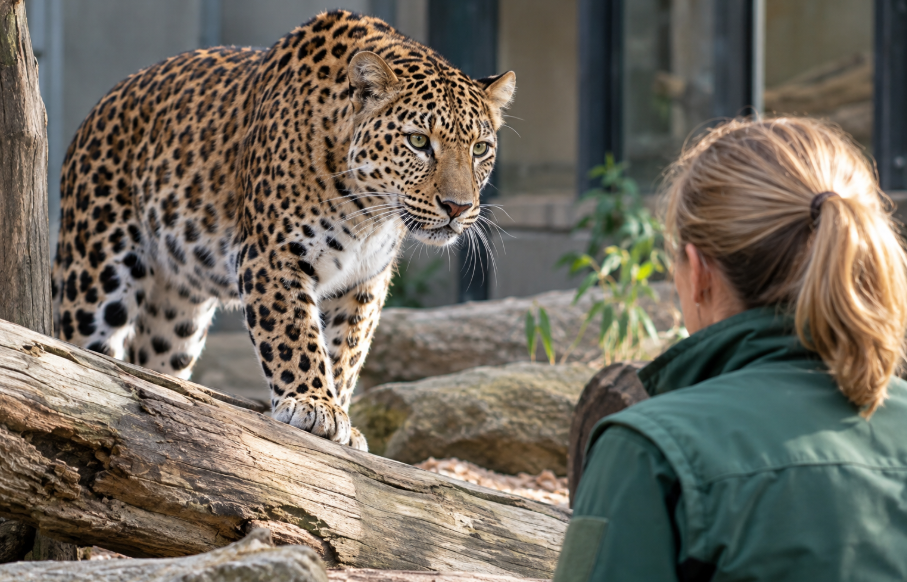
A veteran zookeeper is fighting for her life after being attacked by a leopard inside an animal enclosure in the Netherlands, with horrified coworkers rushing to her rescue after hearing her desperate cries for help over a walkie-talkie.
The frightening incident happened around 11 a.m. Saturday, October 24, at Safaripark Beekse Bergen in Hilvarenbeek, a popular wildlife attraction in the southern Netherlands.
The woman, who is in her 50s, suffered serious injuries to her head during the encounter with a Persian leopard, one of two large cats housed at the facility.
She was rushed to a nearby hospital, where doctors performed emergency surgery.
Although the operation was successful, zoo officials confirmed Sunday that her condition remains critical. She is being kept sedated and has not yet regained consciousness.
The attack is particularly shocking because the injured employee is one of the park’s most experienced animal caretakers.
She has worked at Beekse Bergen for 25 years and spent the past eight years caring for its large predators.
According to zoo officials, the woman was conducting her regular morning rounds with a colleague when she entered an indoor enclosure alone.
The two Persian leopards had been moved inside because of severe weather the previous evening, when Storm Austen brought strong winds to the region.
Somehow, the experienced caretaker ended up in the same enclosure as one of the powerful predators.
The exact circumstances remain unclear.
During the attack, the woman managed to call for help using her walkie-talkie.
A nearby coworker heard her cries and immediately rushed to the enclosure, where the injured zookeeper was discovered.
Other employees quickly alerted emergency services, prompting a major response involving ambulances and a medical helicopter.
Paramedics treated the woman at the scene before she was transported to a hospital for emergency care.
The park’s head of animal care, Martin van Hees, described the incident as deeply distressing.
He emphasized that the injured woman was highly experienced and had always been attentive to safety procedures.
“We know there is a risk when working with dangerous animals, but you never want to experience something like this,” Van Hees told Dutch media.
The attack has left employees shaken, particularly because the park has strict procedures intended to prevent direct contact between caretakers and dangerous predators.
Normally, workers are not supposed to enter an enclosure while a leopard is present.
Although employees conduct their rounds in pairs, they sometimes enter individual sections separately while remaining close enough to assist one another.
That system is designed to reduce the risk of accidental contact with the animals.
Investigators are now trying to determine how the safety procedures failed and why the woman was able to enter an occupied enclosure.
One question involves whether she knew that the leopards had been moved indoors because of the storm.
Zoo officials said the animals’ location had been documented and communicated during staff handovers, but investigators have not established whether the injured caretaker received that information.
Complicating the investigation is the fact that there are no surveillance cameras inside the enclosure.
The Dutch Labor Inspectorate has opened an investigation, while the zoo is conducting its own internal review.
Officials have not determined whether one or both leopards were involved in the attack.
Despite the severity of the incident, the zoo has confirmed that neither animal will be euthanized.
Van Hees explained that the leopard was behaving according to its natural instincts and should not be punished for the encounter.
Persian leopards, also known as Caucasian leopards, are among the largest leopard subspecies. Native to parts of western and central Asia, they are powerful predators capable of bringing down prey considerably larger than themselves.
Although generally solitary and elusive in the wild, they remain dangerous animals that require strict safety precautions in captivity.
The park’s management emphasized that the incident was not caused by an escaped animal and that visitors were never in danger.
Beekse Bergen remained open following the attack, and officials said the leopards would continue receiving their normal care.
Support services have also been arranged for employees affected by the traumatic incident.
The latest medical update has offered a small measure of hope.
A zoo spokesperson confirmed Sunday morning that the injured caretaker survived the night and that Saturday’s surgery went as planned.
However, doctors remain concerned about her condition, and she continues receiving intensive medical care.
Her identity has not been publicly released, and her family has been notified.
For her colleagues, the priority is her recovery while investigators work to understand how such a frightening accident could happen to someone with decades of experience.
Discover more from
Subscribe to get the latest posts sent to your email.
 abnormalpsychteam