

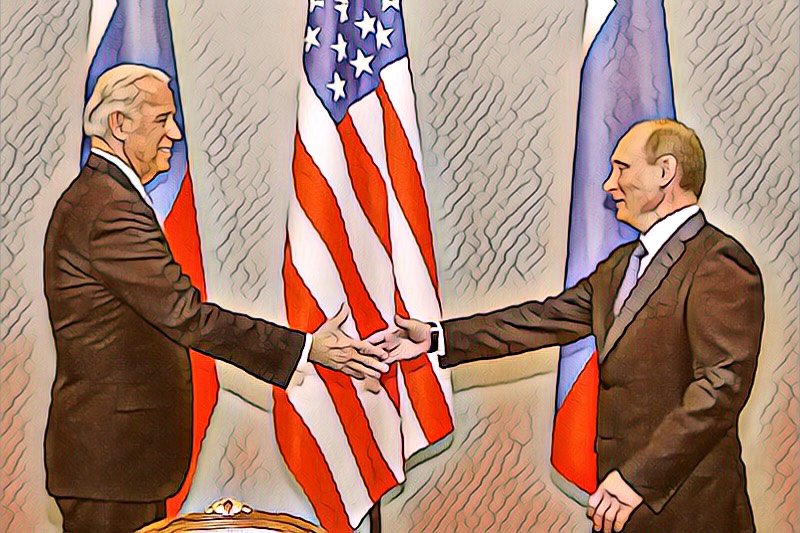
Despite President Joe Biden’s commitment to imposing sanctions and crippling Russia’s economy, US companies continue to send $1 billion each year to Russia’s state-owned nuclear agency, Rosatom, according to a report by The New York Times. These payments are made for enriched uranium, making it one of the largest sources of cash flowing from the US to Russia since the sanctions were imposed due to Russia’s invasion of Ukraine.
Rosatom, which forcefully took control of Ukraine’s Zaporizhzhia nuclear power plant in March 2022, receives the money through its subsidiaries. In 2022 alone, US companies spent approximately $1 billion on purchasing nuclear fuel from Rosatom, and between January and March 2023, the US imported an additional $411.5 million in enriched uranium.
President Biden had vowed to inflict economic damage on Russia, stating in his State of the Union address that the US was causing pain for Russia and supporting Ukraine, isolating President Putin from the rest of the world. However, nuclear fuel is one of the few energy sources that has not been banned by Western sanctions against Russia, as reported by The Wall Street Journal.
While some sanctions were imposed by the White House on Rosatom and its executives in February, Western firms maintain significant ties with the Russian atomic company, which holds a dominant position in the nuclear supply chain. Antony Froggatt, deputy director of the Environment and Society Centre at London-based policy institute Chatham House, noted that nuclear fuel has received less attention in terms of sanctions compared to other sectors.
Although the nuclear fuel market represents a small proportion of the losses incurred by Russia due to sanctions, $1 billion is a substantial portion of Rosatom’s foreign earnings, estimated at $8 billion per year, according to The Washington Post.
Froggatt emphasized the need for scrutiny across all energy sources, stating that no sector should be exempt from scrutiny, even if financially less significant. He called for a comprehensive approach to policy equity.
The US’s dependence on Russia for nuclear energy stems from historical factors. Since the Cold War, Russia has been exporting cheap enriched uranium to the US, aided by its dominant position in the global market, supplying around 43% of the world’s enriched uranium. In contrast, the US has largely halted domestic uranium enrichment. As a result, the US has become commercially reliant on Russia, with approximately one-third of enriched uranium used in the country being imported from Russia.
This dependence extends beyond the US, as central European countries still operate Soviet-era nuclear power plants and heavily rely on Rosatom for their operation. Froggatt highlighted Rosatom’s global ambitions and its extensive nuclear technology export program.
While the nuclear fuel market’s financial significance may be modest compared to other sectors impacted by sanctions, the ongoing flow of funds raises questions about the broader equity and consistency of policies targeting Russia’s economy.
Discover more from True News Media
Subscribe to get the latest posts sent to your email.
What’s so difficult in stopping payments?Oh, I know kickbacks.