

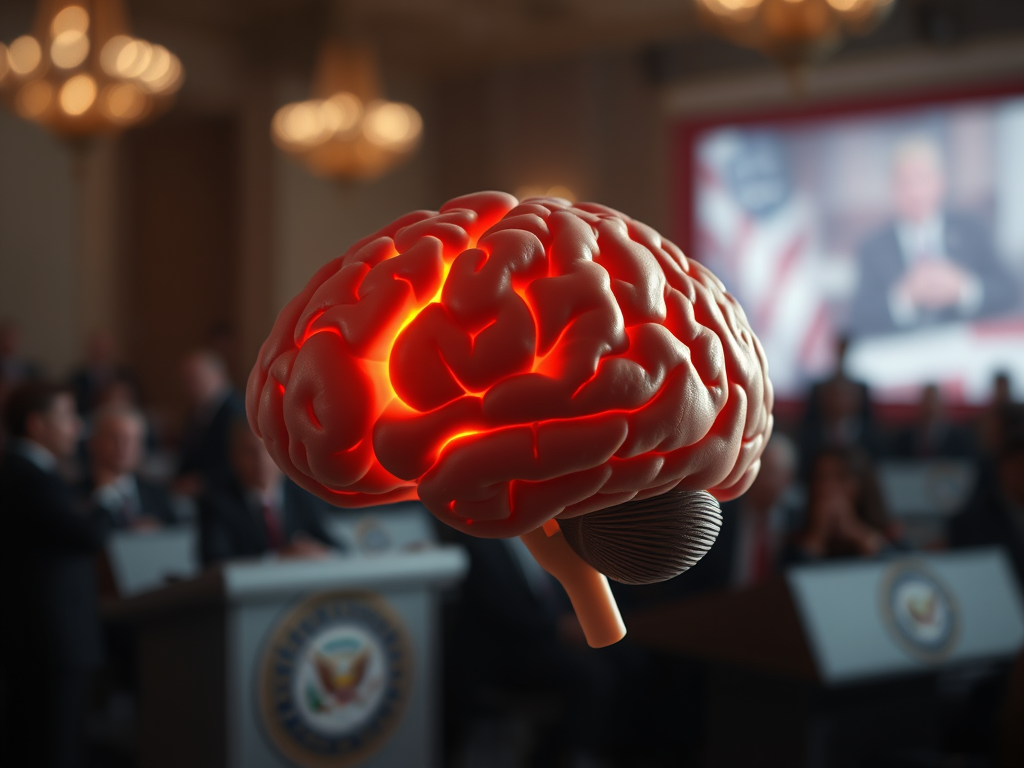
Forget the debate over crowd sizes; it turns out there’s something far more intriguing when it comes to conservatives: the size of their amygdalas. A new study has found that conservatives boast slightly larger amygdalas—the part of the brain responsible for identifying and reacting to threats—than liberals. This fascinating revelation is bound to shake up discussions about political ideology, perhaps in ways we didn’t expect.
Diamantis Petropoulos Petalas, the study’s author, sheds light on what this means. According to Petropoulos, “A slightly larger amygdala simply highlights a brain’s increased sensitivity to issues related to the need for security, reduction of uncertainty, and threat, or perhaps more careful processing of negative stimuli.” In other words, conservatives might just have a more finely tuned radar for danger, leading them to prioritize safety and stability.
Now, some of you might remember that this isn’t the first time scientists have suggested a connection between brain structure and political beliefs. The amygdala finding was first reported in 2011, where a study of 90 university students indicated conservatives tend to have larger amygdalas. This latest study, published Thursday in the journal iScience, aimed to replicate those findings on a much larger scale.
In the new research, Petropoulos’ team analyzed brain scans from 928 Dutch adults between the ages of 19 and 26. Alongside the scans, they gathered information on the participants’ social and economic identities. Questions ranged from their political party identification to where they stood on social issues like LGBTQ rights, women’s rights, and income inequality.
Petropoulos emphasizes the complexity of ideology, noting that it’s “not just about left or right.” Political beliefs encompass a wide array of attitudes on social and economic matters, making the relationship between brain structure and ideology more nuanced than headlines often suggest.
While the new study found a correlation between conservatism and the volume of grey matter in the amygdala, the connection was weaker than the 2011 findings. Conservatives still demonstrated a larger amygdala on average, though by about the size of a sesame seed. But here’s where it gets interesting: Petropoulos’ team didn’t identify a consistent link between politics and the anterior cingulate cortex (ACC)—another brain area involved in error detection, impulse control, and emotional regulation—which the original study had flagged.
For those who’ve been paying attention, the 2011 study was widely discussed in the media with sensational headlines like “Conservatives Big on Fear” and “Conservatives Are Scaredy Cats.” Yet, Petropoulos points out an irony: that same study found liberals have a larger ACC, which deals with error detection. But let’s be real; “Liberals Big on Error Detection” doesn’t quite have the same ring, does it?
This time around, Petropoulos and his team call for further research to delve into the “complex relationship” between brain structure and political beliefs. The study suggests that our political leanings might not be just a product of upbringing or social environment but also of inherent neurological differences. Is it genetics? Is it a result of one’s environment, or a mix of both? The answer is far from clear.
So, what do we make of this? Conservatives, it appears, may have a brain that is naturally more attuned to danger, security, and caution. This could explain why conservative ideals often center on maintaining order, strengthening national security, and reducing uncertainty. It’s not about fear-mongering—it’s about a heightened awareness that some of us are just wired to have.
But liberals, don’t feel left out! If anything, these findings highlight the diversity of thought in our society. Having different neurological wiring means that we approach life’s challenges from unique angles, contributing to a more balanced debate on how to best navigate the world’s complexities.
In the end, while the connection between brain structure and ideology is still being untangled, one thing is clear: there’s a lot more going on in our heads than simple slogans and political talking points can capture. If we’re going to talk about bridging divides, maybe we should start with understanding that our brains—and not just our opinions—play a key role in shaping how we see the world.
Discover more from
Subscribe to get the latest posts sent to your email.