

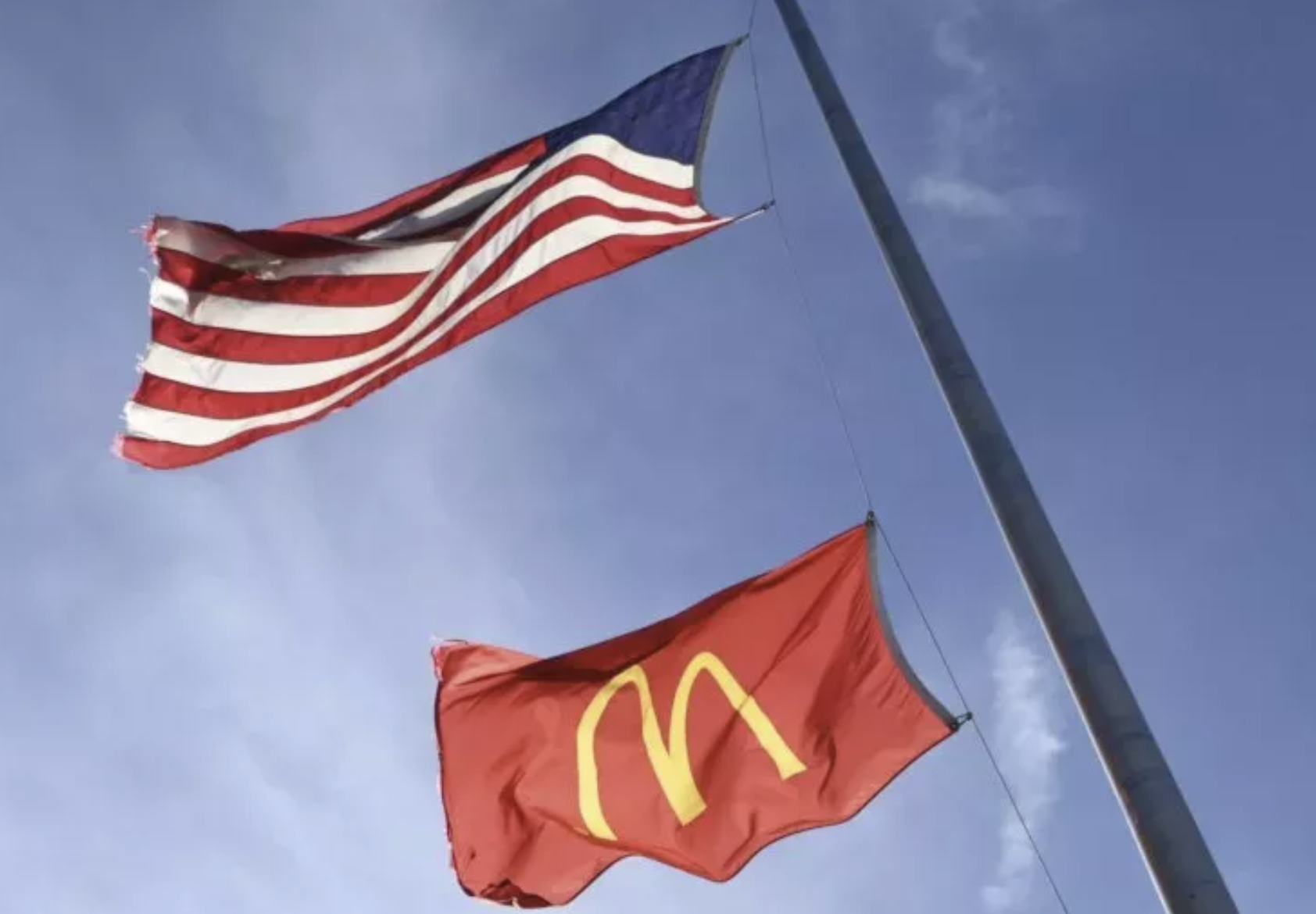
American brands — from McDonald’s and Levi’s to Jack Daniel’s and Coca-Cola — are facing a growing storm overseas as backlash against President Donald Trump’s aggressive tariff policies spreads across the globe.
What started as frustration over trade disputes has evolved into something bigger: a rising wave of anti-American sentiment that could threaten billions in corporate profits and reshape the global consumer market.
In April, Trump reimposed sweeping “reciprocal tariffs,” claiming they would “level the playing field” for U.S. companies. But international markets saw it differently.
From Canada to India, consumer boycotts are gaining momentum. In Canada, Trump’s infamous remark referring to the country as “America’s 51st state” sparked protests and fueled calls to “buy Canadian.”
India has seen a similar shift after Trump slapped a 50% duty on key exports. Lawmakers there are urging citizens to “turn away from U.S. products” and prioritize local industries.
“This isn’t just about trade anymore,” said Usha Haley, an international business expert at Wichita State University. “It’s about identity. In countries where consumers take pride in local brands, anti-American sentiment translates directly into lost sales.”
McDonald’s, Levi’s, and Jack Daniel’s are among the companies sounding the alarm.
Chris Kempczinski, McDonald’s CEO, told CNBC this week that the company’s global surveys show an “8 to 10-point spike in anti-American sentiment” in key markets, particularly in Northern Europe and Canada.
“The aura around America has dimmed,” he admitted. “We’re leaning more on our local identity rather than our Americanness.”
Brown-Forman, the parent company of Jack Daniel’s, reported a staggering 62% drop in Canadian sales compared to last year. Executives blamed tariffs and “a growing cultural backlash” against American whiskey.
Levi Strauss & Co. issued a stark warning in its SEC filings, citing “rising anti-Americanism as a consequence of Trump’s tariffs” as one of its top business risks for 2025.
Beyond Meat, the California-based plant-based food company, also flagged the danger in its annual report:
“There is no assurance we could pass on cost increases or avoid losing customers in markets like Canada due to anti-American sentiment,” the filing said.
According to Morning Consult, global favorability toward U.S. brands has plummeted since April, with some companies seeing “steep drops in purchasing consideration” overseas.
Alan Bradshaw, a marketing professor at Royal Holloway, University of London, warns that iconic brands like Hershey’s, Coca-Cola, Budweiser, and Nike — companies built on “Americana” — are particularly vulnerable.
“These are brands that trade on being American,” Bradshaw explained. “If being American turns toxic abroad, they either adapt their image or face long-term erosion in brand equity.”
The situation could soon get even messier.
This week, a federal appeals court ruled that most of Trump’s tariffs were illegally imposed and represented an “unjustified use of presidential emergency powers.” The decision is set to take effect on October 14 unless the Supreme Court intervenes.
Trump blasted the ruling as “ridiculous” during a press conference Friday, vowing to fight it:
“We are protecting American workers. Nobody is going to tell us we can’t stand up for our country,” he said.
Business leaders, however, warn that if the tariffs remain, U.S. companies could face an unprecedented consumer backlash abroad.
Experts say the next few months will be critical for American companies heavily dependent on international sales. If boycotts continue to grow, companies may be forced to localize their branding, rethink pricing strategies, or even scale back global expansion plans.
Takeshi Niinami, CEO of Japan’s Suntory Holdings, which owns Jim Beam and Maker’s Mark, warned:
“If this continues, America won’t be an attractive place to invest. Companies are already looking elsewhere — India, Indonesia, Europe. The U.S. risks losing its edge.”
For now, the Trump administration shows no sign of backing down, even as critics warn of lasting damage to America’s image — and its brands — worldwide.
Discover more from True News Media
Subscribe to get the latest posts sent to your email.
Well about time these companies take a look at what they have done to humans.I use the Coca-Cola to clean the toilet.Iaminamother country and stop buying McDonald’s because of the junk in their food.I amsure if you make healthy products you will not have any problems selling them
The is nonsense as usual. Sent from my iPhone
Canada started their own problems by charging 300% for dairy products and no less than 25% for everything else. Most were well over 25% President Trump offered them 0% for 0% and they refused. They are their own worst enemies. And wow, both Canada and Europe might be speaking German if it was not for the United States. So go ahead. Buy Canadian, and we will buy American.
The United States provided food products for free to nations during World War II through various programs. The Lend-Lease Act, signed in March 1941, authorized the provision of food, weapons, and other supplies to Allied nations, including the United Kingdom, China, and the Soviet Union, without immediate payment, effectively providing them for free as part of the war effort.
This program was a major component of U.S. foreign policy during the war, with the United States shipping vast quantities of food and other goods to support Allied nations.
Additionally, the United Nations Relief and Rehabilitation Administration (UNRRA), spearheaded by the United States, distributed $4.5 billion in food and supplies to war-torn countries in Europe after the war began, including food aid provided free of charge.
The U.S. also provided significant food shipments to Europe and Japan from July 1945 through June 1946, amounting to 16.5 million tons of food, primarily wheat, to help alleviate severe food shortages.
Such gratitude.
By the way, if you destroy the US economy, just where will you get the money you are looking for? Will not likely be forthcoming from anywhere else.